
For people with Parkinson’s, assistive devices are a must. If you don’t need one today, there may be a day when you will. The progression of the disease differs from person to person, but it is likely that anyone diagnosed with Parkinson’s will require some kind of assistive device(s). And, different days present different challenges, so different kinds of devices are needed depending upon the stage of the illness and the amount of exercise the person does.
Walking is complicated business. Have you ever watched a toddler walk? He/she struggles with balance and putting one foot in front of the other. Walking for people with Parkinson’s is like that. It can be frustrating for the person afflicted as well as his/her caregiver(s). Once we learn how to walk, most of us tend to take it for granted unless we suffer from an accident or debilitating illness like Parkinson’s.
The first assistive device that George used was a traditional metal cane. this helped him for quite a while. Four years ago, it was all he needed for support.
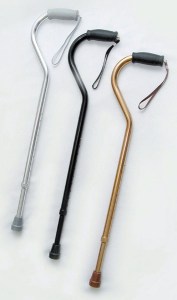
- Traditional Metal Canes
It was adjustable in length, but supported him on only one side. However, it was also relatively inexpensive, so it was a good first choice.
As his tremors were more pronounced on his right side (a phenomenon of Parkinson’s tremors seems to be that the dominant side is worse), he began to use the cane in his left hand, thereby putting more stress on the muscles of that side.
I believe that using a cane in one hand (his left) for a long time contributed to what recently has been diagnosed as a mild carpal tunnel syndrome.
The second cane we acquired was called the “Hurrycane.” This one was more stable because it features three feet at the bottom. Just like a three-legged stool, it is much harder to tip over. Another great thing about it was that it conveniently folded for travel. It could easily be stashed in a carryon bag to take up little space when travelling by air. I thought it was a clever, innovative design, but for an unknown reason, George seemed to prefer using the traditional metal can for quite a while.

As George’s mobility lessened, it became apparent that he needed to use a walker to provide a way for him to hold on with both hands while keeping him balanced. We purchased a walker manufactured by Drive. It features a flip up/flip down seat, is lightweight, and folds easily for travel.
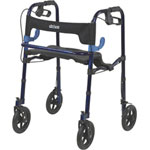
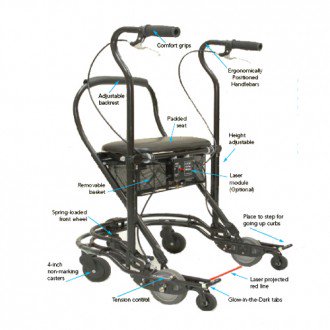
Primarily due to freezing episodes, George’s Occupational Therapist recommended an improved walker: the UStep II. Traditional rollators are difficult to move except in straight lines. The UStep II has a much better turning radius, and is more stable because of extra wheels. A laser light visual cue, and metronome-like audible cue provides guidance for where the user’s feet should be. Fortunately, we were able to have Medicare pay for this device, except for the optional storage bag and laser light.
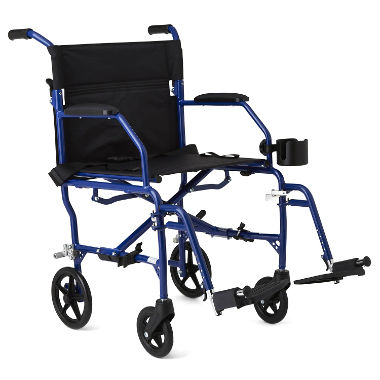
In January, 2017, George had to have some minor surgery unrelated to his Parkinson’s. We anticipated that he would be weaker after the general anesthesia. We decided that help would be needed to get home and get in and out of the car. So, we purchased a transport chair. It was day surgery, but thankfully, we were able to request the doctor to keep him overnight for observation. Even so, it was a good thing we had the chair. He was able to get into the car at the hospital, and get out of the car when we arrived home. However, he had a fall when he tried to move from the transport chair to his recliner.
Ever since, we have used it for long doctor visits where we need to make his transport easier. It is much lighter than a regular wheelchair, and I can easily fold and lift it to carry in the back of our small SUV. It is also lighter than the U Step II Walker. The good news is that most days we do not need this right now (he is in Stage 2 Parkinson’s), and the walker is all he needs.
Recently, George acquired a new device! It encourages a more upright posture. The photos illustrate how a traditional walker/rollator can actually cause the user to have a more hunched-over posture. George has severe arthritis in his shoulder, and mild carpal tunnel syndrome in his wrist. This was exacerbated by weakness in his legs; he started pushing himself up and lowering himself down with his arms rather than using the glutes and leg muscles that are intended for such movements. He will require a physical therapist to teach him how to properly use this new device, as it works differently from the walkers he used previously. We are hopeful that this will help his posture, help to strengthen his back muscles, and improve his confidence.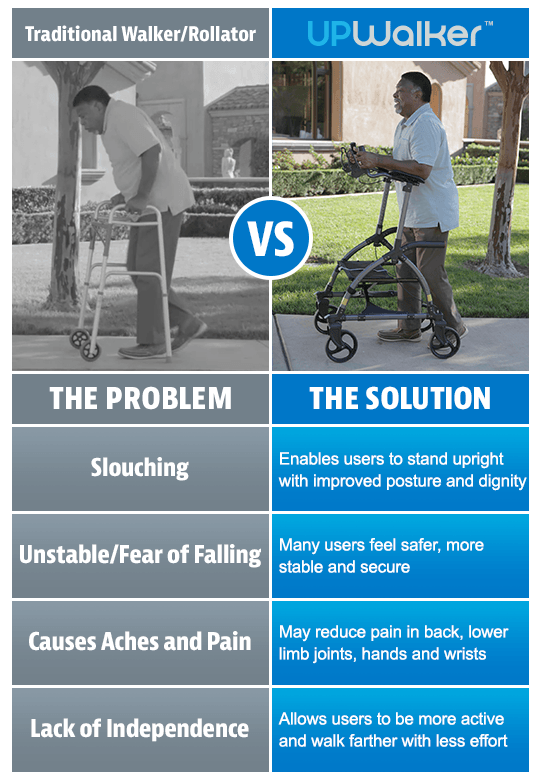 Mechanical assistive devices are great, but they should always be used with the assistance provided by caregivers, physical and/or occupational therapists. Fatigue and balance problems plague People with Parkinson’s, and the canes, walkers, or chairs should always be inspected frequently to ensure that the brakes work properly and that all parts are securely attached together.
Take care when using a new device, and make sure that your loved one understands how to safely use it. Consult a physical therapist if needed.
 Perpetual Motion
I had not heard of the Upwalker. Of course, it makes perfect sense! I’m so glad you are on top of all the assistance devices George can use. He is SO lucky to have you!
LikeLike
Actually, it was George who saw this new type of walker advertised on TV. I frequently “tune out” commercials, but not this time! With the help of the physical therapist, we think it will benefit him greatly.
LikeLike