The Broken Clock

At this dawn of a new year, we may be glad to say “goodbye” to 2020 and to welcome 2021 with a renewed sense of hope for the future. The Coronavirus Pandemic has made 2020 seem to be a difficult year, and like that Bill Murray movie: “Groundhog Day,” we would not want to be caught in a deja vu world where we have to relive a day, week, month, or year over and over! As for me, I say “good riddance” to 2020!

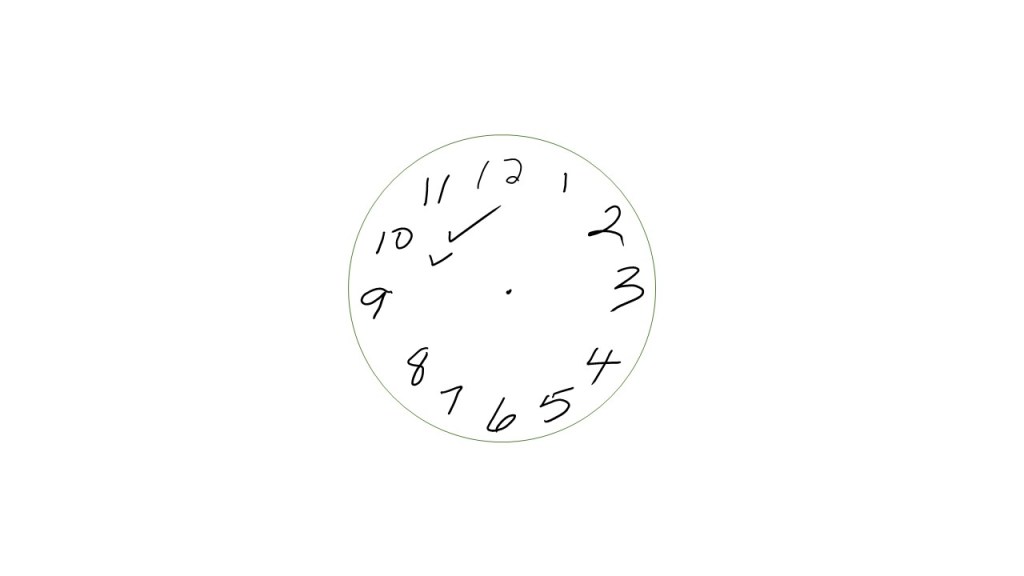
Last week, my PWP had an annual checkup with his primary care provider. Those of you who are of a “certain age” recognize some of the wellness tests that are administered at such a visit. A standard one is to draw an analog clock face, add the numerals, and draw the hands indicating 10 minutes after 11. Today’s young children who have never seen an analog clock might not be able to do this, but for those of us in our generation, it is a good test of cognitive health. In the past, he has generally been slow at doing this, but he would eventually get it done with a “good job” encouragement from the nurse. Last week was different. I was actually shocked that his clock looked similar to this:
The Broken Clock

As we sat there and he struggled with this task, I was filled with despair. My intelligent husband, who had once done complicated mathematics mentally, was unable to reproduce a clock face. He had apparently forgotten how to draw the short and long hands of a clock, even though the numbers were correct. Finally, the nurse realized that there was a limited amount of time for the visit, so she said “that’s fine,” and he handed her the paper.

It was a frustrating morning for us both, as the routine medical tests that all doctors require (urinalysis, chest x-ray, and EKG) proved very difficult for him to complete. As it turned out, we were there for about four hours and we were both exhausted at the end. Parkinson’s Disease will do that to both the “Parkie” and the caregiver.

After we returned home, and I had had a chance to rest and unwind, my thoughts turned to our concepts of time and how humankind has created artificial devices to measure it. Is our clock divinely created? I doubt it. Instead, it was created by our human need to understand how a day can be divided for our own purposes. The Book of Genesis tells us that God said “Let there be light,” and there was light; and God saw that the light was good, and he separated light from darkness. The earth, the sun, the moon, and all the stars in the Cosmos were not created by mankind. Mankind invited clocks. Then I wondered: was George’s clock actually “broken?” It made sense to him, and now it makes sense to me.

During this difficult, tempestuous, pandemic year, I am reminded of how I perceived time as a small child. Probably because of my interest in history, I started thinking of the centuries and eons in a kind of mental timeline. As a child, I could not see into the future beyond about the year 2000. Now we are here in 2020, and only God knows how long the earth’s timeline will be, and how long each individual’s timeline will be. I am thankful that we actually cannot know when our respective timelines will end. In the meantime, we just need to live each day to the fullest and avoid looking at the clock.

Parkinson’s and COVID-19

According to the American Parkinson’s Disease Association (APDA), there are several things to think about if you or a loved one have PD. Go to https://www.apdaparkinson.org/article/questions-about-pd-and-covid-19/C to read more, but in short, here are the important things to remember:

  • COVID-19 is a novel virus and information on how it behaves is continuously evolving.
  • Most people who are infected with COVID-19 will recover completely. However, older adults and those with underlying medical issues are at an increased risk of developing serious outcomes from COVID-19 as compared to those who are younger and healthier.
  • It is incredibly important for everyone, especially the PD community, to follow all recommended risk-reduction guidelines and adhere to local regulations.
  • PD symptoms such as balance problems/falls, swallowing difficulties, urinary dysfunction and weight loss contribute to general frailty and increased risk of infection, including increased risk from COVID-19.
  • Talk with your doctor about any concerns you have about COVID-19.

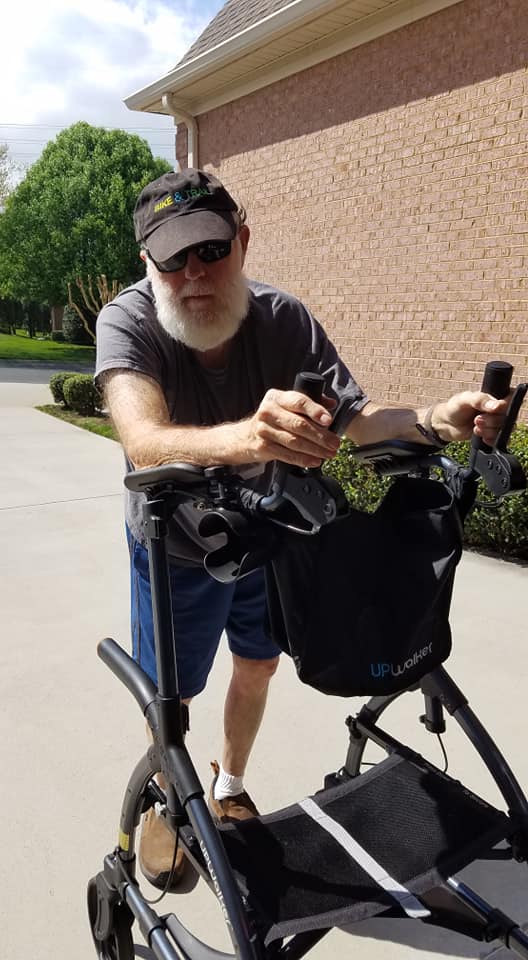
I believe that one of the most important things that Parkinson’s Caregivers can do for their loved ones is to ensure that they maintain their normal activities insofar as they can. This could be as simple as walking outdoors when weather permits. Thankfully, the weather here has been good the past few days, so we appreciate going outside while maintaining a safe distance from neighbors. In the photo below, my PWP is using the UpWalker, which is available online (not sold at Lambert’s or other local stores).

If it’s raining, we try to walk around the condo about every hour. A couple of years ago, we acquired a bike-type exerciser on line that can be used while sitting to keep legs strong. My PWP also has a hand exerciser that he can use while sitting in his recliner. As he has lost hand strength, this is very beneficial and provides him with a focus if the dyskenesia starts.

Just as important as the physical exercise is social interaction. We have used Hangouts to talk to, and to see our daughter and son-in-law and our three grandchildren! The soon to be three year old always makes us laugh! Great for our spirits.

Tears in Heaven

One of my favorite songs from 1992 is Tears in Heaven, written by Eric Clapton and Will Jennings, and recorded by Eric Clapton. It is a bittersweet, melancholy song that was written in honor of his four year old son Conor who tragically fell to his death from a New York City apartment building.

It’s funny, but while I seemed to cry easily as a child, adolescent, and young adult, age has made it more difficult to cry. They say that crying is a good thing, because it can release negative emotions and can therefore, be very cathartic. I used to cry with anger, and I hated that, because I wanted to appear tough and able to handle anything. Now, I cry from sadness or saccharine stories. Oh yes, I cry from happy things as well.

My Person with Parkinson’s was always one who avoided crying, probably because he wanted to appear tough as well. However, lately he has begun to cry more easily. Is it Parkinson’s? Is it his PD medications? Perhaps it is a combination of both. While talking about his dad, or friends who have passed away, the tears will begin to flow. Obviously, grieving for lost loved ones is natural for all of us. But, death is not the only thing that can cause people to grieve. For George, I think it is more likely that he is experiencing grief over loss of his former abilities. The grief is real, not only for people with Parkinson’s, but also for their caregivers. George’s sadness does make me sad too. Is sadness contagious? I prefer to think I have empathy with him. So, when he cries, my tears now come more easily.

Walking is a struggle, eating is difficult, and many of the activities that you and I take for granted are virtually impossible. Yet, we continue to strive to accentuate the positive. In meeting with our Parkinson’s Support Group, I have learned that the most successful of those fighting the PD battle do the same. Living one day at a time, learning to adjust to our changing state of normal, is essential.

Here are the lyrics of Tears in Heaven:

Would you know my name
If I saw you in heaven?
Would it be the same
If I saw you in heaven?
I must be strong and carry on
‘Cause I know I don’t belong here in heaven

Would you hold my hand
If I saw you in heaven?
Would you help me stand
If I saw you in heaven?
I’ll find my way through night and day
‘Cause I know I just can’t stay here in heaven

Time can bring you down, time can bend your knees
Time can break your heart, have you begging please, begging please

Beyond the door there’s peace I’m sure
And I know there’ll be no more tears in heaven

Would you know my name
If I saw you in heaven?
Would it be the same
If I saw you in heaven?
I must be strong and carry on
‘Cause I know I don’t belong here in heaven

My Faith assures me that there will be a day when there will be no more tears. Thanks be to God.

Targeting at Target

Yesterday was a beautiful, (and in my humble opinion) a productive day. Once the regular morning chores were out of the way, George and I took a walk, had lunch, and visited our friend Jack to pick up a small folding workbench. George thought he needed one (I’m still not sure for what) but I decided that if it afforded him something to focus his mind on rather than television, it was a good thing. After all, some studies have shown that “puttering” is good for people with Parkinson’s. The bench can be set up in our garage to give him a place to organize various things. It is a good height, and the price was right!

After a brief stop at the auto parts store (don’t know what we needed THERE, either!), we headed to Target. I do not intend to create a commercial for this department store, but we do like it. It is convenient to our home, offers many items we shop for, and if we need a couple of grocery items, we can get those at the same time. The thing that appeals most to George is the fact that Target has battery-powered carts on which he can ride through the store.

Generally, I don’t mind spending time “just looking” in stores when I have the time to do it. However, yesterday, it was approaching 5:00 pm and by that time I was getting hungry! You see, while George is casually and comfortably riding on his cart, I’m having to walk up and down every aisle. That is not necessarily a bad thing, but I thought “enough is enough!” (The good part was that I almost reached my goal of walking 10,000 steps yesterday!)

You may be aware that some of the medications for Parkinson’s (such as carbidopa-levodopa) can exacerbate obsessive-compulsive behaviors, so George’s shopping forays have become just that. It seems that he wants to buy things we have no need for, and while I understand his condition, I can lose patience (especially when I’m hungry!).

Before we left the store, George became confused. There were two reasons for this: (1) only one cashier was open, and (2) there was a lengthy line of folks waiting to check out. When a cashier came to open another lane, I started to unload our cart, only to learn that she was unable to access the computer with her password! More confusion ensued. When I tried to explain to George that he had to go to a different cashier, it was bedlam. He turned the cart in the absolute wrong direction, and rammed into a display shelf and almost wiped out another cart and customer! Needless to say, my blood pressure began to rise. When we finally got turned around, a kind person rearranged the display where several items had fallen to the floor.

It has been said that no one dies from embarrassment, which is a good thing, and explains why I am still living today!

In football, “targeting” is a severe penalty whereby a player can be ejected from the game for deliberately tackling the ball carrier in a dangerous way. On an intellectual level, I of course know that George did not hit anything deliberately. However, on an emotional level, I fear I may “penalize” George for “targeting at Target.” It will be a while before we return to our favorite store.

Waiting for the Other Shoe to Drop

Lately we have been having many good days. As I am fond of saying, there are “good days” and “better days!” However, let’s face it. Some days are just bad.

Just when I have decided that my PWP is getting better, we had a kind of relapse. 3:00 last Tuesday morning was one of those times. Yesterday was a great, productive day. The condo was cleaned, I did laundry (never-ending task that is!), and I worked to spruce up my outdoor patio area. Being outdoors with the trees and flowers always makes me feel better! And, Monday night I had the pleasure of attending our local American Guild of Organists chapter members’ recital. After an uplifting day outside, I was able to also have an uplifting evening of live organ music to feed my soul. We are grateful that our in-home caregiver could be here to enable me to do that.

One thing that George did not do on Monday was to walk outside so he could also enjoy the beautiful weather. It was rather warm, but we figured it was more important to get a shower than it was to sweat more! Daily walks always help his sleep, so I was concerned that he might have a restless night without it. As it turned out, he did.

My physical tiredness compelled me to go on to bed. Generally, I won’t do that until I know George is settled into his bed and ready to sleep; however, I made the mistake of falling asleep. Then, around 3:00 am, George was attempting to walk into the bathroom and he fell. Getting him back into bed was no small feat. We were able to “scoot” across the floor (tile and hardwood) until he could reach the bedside where we have side rails. The bed is stable enough so he could pull himself up, and then, after about 30 minutes of moving from one room to the other, he could pull up using the side rails. He could not have done this without weekly physical therapy sessions. Afterwards, I was able to breathe a sigh of relief, but found it extremely difficult to fall back to sleep as I was “waiting for the other shoe to drop.”

A few lessons learned from this experience:

  1. Make daily exercise a priority.
  2. Make medication times and bedtimes consistent.
  3. Ensure that assistive devices (e.g., grab bars, bed side rails, walkers) are available and sturdy.
  4. Don’t try to lift a person on the floor, rather, find a way to “scoot” to a place.
  5. Keep positive, calm, and think of safe ways to move and get into a safer place.

How long will I be able to keep this up? It is a rhetorical question, but I continue to pray for daily strength (both physical and spiritual) to give him proper care.

Mind over Body

One of the things that I have learned from my musical activities is that if you think you can do something, you generally can. “Natural” talent can only take you so far. Hard work and dedicated practice obviously makes a real difference as well. Unfortunately, anxiety can impact the quality of a musician’s performance. In my own experience, if I just “think” a note is too high, then it is. Over time, I have learned several tricks to convince myself that the notes are in a comfortable range.

Athletes also can have problems with performance anxiety. This is particularly noticeable in football placekickers who miss an easy “chip shot” because they think they cannot make the kick. This is why the opposing team typically “ices” the kicker by calling a timeout just as he is about to prepare for his kick. I am a fan of UT basketball (both men and women), and I continue to be amazed how some players can hit their free-throws consistently while others have a lot of misses. Does the basketball player suffer from performance anxiety too? I think that sometimes, the answer is “yes.”

People with Parkinson’s may also suffer from performance anxiety. Balance issues, an inadequate amount of dopamine, and fear of falling can all effect the PWP’s mobility. Recently, my PWP had a stressful day for several reasons. I had been gone for a while, the grandchildren came to play and their natural youthful exuberance and playfulness distracted him. It was evening, so he was also physically tired. However, he had been moving fairly well all day. Then, it happened. We realized that he had missed his evening medications, and suddenly, his stress and anxiety about being able to move fluidly caused him to “freeze.” He said “I can’t” and it was a self-fulfilling prophecy. We used a common strategy which is to count rhythmically: “1, 2, 3, 4” to get him moving again. And, our grandson said: “You can do it, Gramps!” Then, once the medications took effect, and he had convinced himself that he could, he was able to start walking again and was fine.

Some of the strategies that musicians and athletes use can be most helpful for PWPs as well. A few ideas follow.

  • Be prepared: practice, practice, practice. For walking, this means “keep moving!” The more George moves, the better he can move. The adage “use it or lose it” certainly applies here.
  • Limit caffeine and sugar intake. Sensible meals that are not too high in protein (which limits the absorption of carbodopa-levodopa) can ensure adequate energy for movement. Higher protein meals are best in the evening. Low-fat meals including complex carbohydrates are all good choices.
  • Don’t focus on what could go wrong. Instead focus on the positive. Visualize your success.
  • Avoid thoughts that produce self-doubt.
  • Practice controlled breathing, meditation, biofeedback, and other strategies to help you relax and redirect your thoughts when they turn negative. It is best to practice some type of relaxation technique every day, so that the skill is there for you when you need it.
  • Take a walk, do leg lifts in a chair, do heel raises, shake out your muscles, or do whatever feels right to ease your anxious feelings before starting to move.
  • Regular exercise, a healthy diet, and adequate sleep, all help.


Is there something you want or need to accomplish, but you think you cannot? I’m reminded of today’s Old Testament lesson from the Prophet Jeremiah. The word of the Lord came to Jeremiah saying, “Before I formed you in the womb I knew you, and before you were born I consecrated you; I appointed you a prophet to the nations.” Jeremiah was skeptical. He insisted that he did not know how to speak, as he was just a boy. However, God told him to not be afraid, and He would place the words in Jeremiah’s mouth. While Jeremiah said “I can’t!” God said “You can!”

Like Jeremiah, People with Parkinson’s can tell themselves “I can’t.” This can also be true for caregivers. Some days (especially if I’m sleep deprived or hungry), I think “I can’t!” It is vitally important for all of us to tell ourselves and our loved ones that “Together, we can!”


Magnificent Obsession

If you’ve been in the Parkinson’s caregiver game for long, you know that frequently your person with Parkinson’s can exhibit obsessive behaviors. The principal medication used to treat the illness, carbidopa-levodopa, taken in large quantities (as is necessary in the disease’s later stages) can exacerbate the problem.

Lately, George has become “obsessed” with the features of our cable TV remote. He will tell me he “just wants to learn how it works,” but in so doing, he can easily change device settings that are strange or make no sense to me. Also, he can inadvertently order movies or shows through Comcast On Demand. On a couple of occasions, I have been obliged to contact our friendly Comcast technician to remove the errant charges. This can be annoying to me, and bothers him a great deal, because he doesn’t really understand what he is doing with the remote. Unfortunately, sometimes my patience with this wears thin.

Upon reflection, I must add that George has always been a personality that “obsesses” with behaviors and/or things. He always liked to collect things, and finds it very difficult to discard anything that he has collected. When we moved four years ago, this was an issue for us, but he did finally decide to let go of some items. I have to wonder if he thinks something bad will happen if he throws anything away.

I was recently reminded of a story because of George’s behavior. In 1929, Lloyd C. Douglas wrote a novel called Magnificent Obsession. It is a somewhat “sudsy” story (like a soap opera) but has an underlying spiritual theme that is interesting to me. In my home growing up, we did not have many books so they were extremely valued and memorable. One that my mother had was Magnificent Obsession.

If you are unfamiliar with the story, the synopsis is that a wealthy, self-indulged and reckless playboy wrecks his speedboat and almost drowns. He is saved by the town’s one defibrillator. Unfortunately, the town’s beloved and benevolent doctor suffers a heart attack and dies because the electronic device was in use and so was not available to save his life. The doctor’s widow meets the playboy, and he strives to make amends by offering to pay the family’s debts. In case you would like to read the book or see the movie (two versions, one in 1935 and one in 1954), I won’t give away what happens after that. Suffice it to say that the playboy has a sincere change of heart, falls in love with the widow, and becomes obsessed with helping her.

So, obsessions can be a positive thing. I think that when we are striving to do good and wanting to help our partners, each day can be difficult and we can tire of always being available to be the helper. The perceived negative obsessions can be addressed by counseling and clear, open, and honest communication. I believe when we focus on the love we have and remember what brought us together in the first place, it can make each day bearable.

Love is a magnificent obsession!

High Anxiety

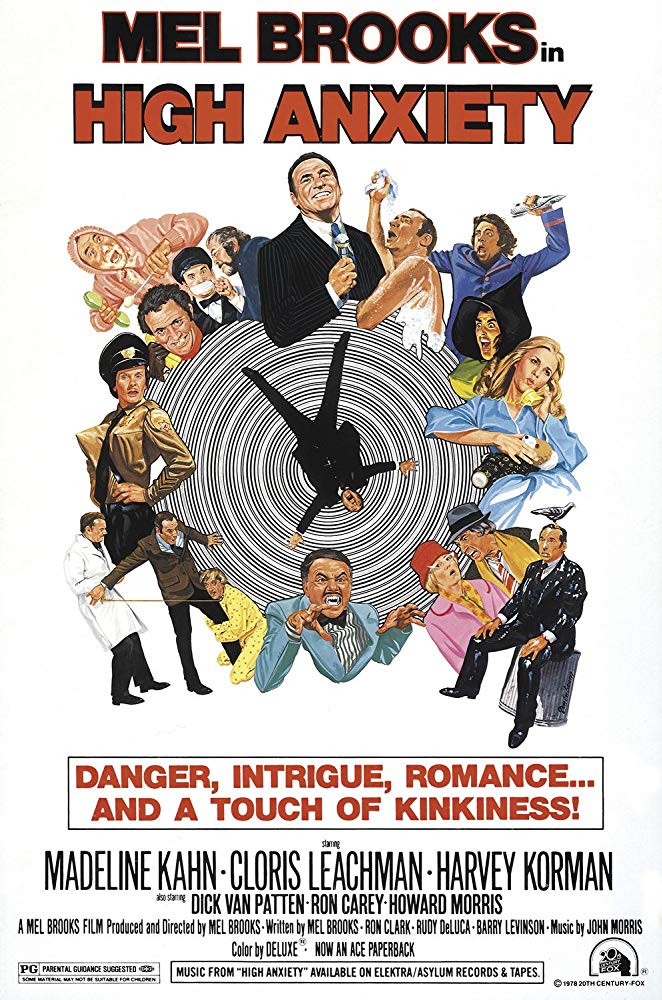
In 1977, Mel Brooks produced, directed, wrote, and starred in a film spoof of Alfred Hitchcock movies. George and I have always been Hitchcock fans, and also fans of Brooks’ somewhat warped sense of humor. It was a funny film, full of laughs, giggles and silliness as only Mel Brooks can create. At one time, we had watched all the Hitchcock films that Brooks parodied (Vertigo, North by Northwest, Psycho, and The Birds), so it was especially clever.

In 1977, attitudes toward mental illness were quite different from what they are today. And, it seems that what people fear or do not understand is often avoided or ridiculed. So we laughed. Today, I would watch this film with new eyes: eyes that have been opened to the fragility of humanity and the fact that depression and anxiety are very real. Mental illnesses must be treated with the right kind of diet, exercise, and medication just like diabetes.

The other night, George and I shared a biblical devotional. This is a practice we started at the beginning of Advent, and when the materials I had came to an end with Christmas Day, George asked that we continue. It was Sunday evening, and I was tired, but I grabbed the closest thing at hand which was that morning’s service leaflet from church. The Gospel was John 1:1-18 which begins “In the beginning was the Word, and the Word was with God…” I read it to him and told him what I could remember from Father Christopher’s homily. In it, he described a visit to the Lost Sea where they placed the cavern in total darkness. One individual (a large “Harley Davidson” biker type) yelled he couldn’t stand the dark any longer, so he lit a match. Father Christopher went on to say that it was striking that a single match could illuminate the entire cavern. Of course, the story was a perfect illustration for Jesus, the Light of the World. Most of us Christians may forget that we have to strike the match to bring light to the world.

As we were winding down and getting ready for sleep, I told him Christopher’s belief that all suffering is caused by anger, fear, or disappointment over unmet desires. And, what is anxiety but fear? It may be “irrational” fear, but it is indeed real to the person who experiences it. To discuss this idea, I asked George: “What are you afraid of?” I wasn’t surprised when he said “I’m afraid when I go to sleep I won’t wake up.” I reminded him of what his neurologist has told us: people die “with Parkinson’s” not “from Parkinson’s.” Then he startled me by saying he was afraid that I wouldn’t wake up. I was actually speechless at that, but tried to comfort him by saying I was in good shape with a strong heart, etc., and I come from a family of long-lived ancestors, so he shouldn’t worry. Nevertheless, I know he does worry, and it is difficult to not fear.

People with Parkinson’s, as well as their caregivers all suffer due to anger, fear, and disappointment over unmet desires. We are mad as hell over having to deal with the illness, we are afraid of the unknown, and our desires for a “normal” life free from illness have been unmet.

I don’t know if Mel Brooks suffers from anxiety in real life, but it seems to me that perhaps he does. If so, I think he used humor to express and overcome a condition that can be debilitating.

It is my hope that all People with Parkinson’s and their caregivers can use whatever works to overcome the debilitating physical, mental, and emotional challenges that they face on a daily basis. A spoonful of humor can’t hurt.

Being Prepared

The motto of the Boy Scouts is “Be Prepared.”  As an avid scouter and troop leader, George was always prepared.  He managed to have multiple tools to do the same job (just in case one of them failed) and always ensured that he had the necessary provisions and camping gear when he went camping or backpacking.  In the spirit of St. Nicholas, he made lists and checked them twice.  He did this in his work as a finance officer, and he did this with his family, which frequently drove the rest of us crazy.  “Check the door locks!”  “Do we have enough milk?”  “Do we have enough toilet paper?”  If I heard these questions once, I heard them a million times.  He always had backup plans for his backup plans!

Lately, however, George has been resistant to doing the work necessary to ensure that all important legal documents, etc. are completed and properly executed.  I could not understand this, as my parents had taught me to thoroughly plan for the future.

When we moved four years ago, I started talking to him about making a will.  I said:  “This doesn’t mean either one of us is going to die tomorrow, but don’t you want to have the peace of mind that our children and grandchildren get our inheritance and not the state?”  Of course, he admitted that was right, but his anxiety and underlying fear of death prevent him from thinking about such things.

No one wants to think about his or her own death.  It is an uncomfortable experience, and therefore is human nature.  Finally, last year I was able to convince him to engage an attorney and execute the wills.  They were simple and straightforward as we are not millionaires!  However, it was like pulling eye teeth.  When all was said and done, the documents were completed.  I breathed a sigh of relief.  However, there was one more thing that I felt was important to do, and that was to establish our final wishes for a funeral.  Somehow, he could just not face this.

It is said that no one dies from Parkinson’s, rather individuals die “with” Parkinson’s.  It can be many years before he succumbs, but the cost of the funeral will be much greater five, 10, or even 20 years from now.  I come from a long-lived family, so I expect to live many years.  Of course, anyone (with or without a debilitating or disabling illness) could die in an automobile accident or the like without any prior warning.

I wanted our children to not have to worry about any of the difficult and emotion-laden details of planning for our burial.  So, thankfully, today (at least two years or more since we started talking about it) we were able to get the necessary paperwork and pre-pay the funeral.  Now it will all be in order.  Today, I breathed another sigh of relief.

I urge everyone to be prepared.

The Comcast Conundrum

Have you ever had issues with your cable company?  Well, I certainly have.  Recently, my person with Parkinson’s decided that the remote control that Comcast provided was too difficult to use.  Especially when his tremors are severe, the buttons were simply too small to manipulate easily.  As television is one of his (only?) favorite pastimes, it was very important for him to control the TV by himself, even if a caregiver was here to help.

So, what did Frances do?  She found a remote that had larger buttons.  This was  a “mini project” that quickly became a “major project” because George became inpatient with the old one.

Below is a picture of his new remote, nearly actual size:

ComcastBigButtonRemote

After going through the  Comcast phone support merry-go-round, I was finally able to speak to a person who could place an order for the subject remote.  Happily, Comcast did not charge us for this device.  And, the helpful tech support person asked:  “Do you have another cable box/TV in another room?”  Well, of course, the answer was “yes,” and then “Do you want a remote for both TVs?”  And, of course, the answer was again “yes!”

Next the waiting began.  The devices were shipped within about five business days, so our wait was worth it.  We were excited when they arrived.  Only problem was that Geo’s “personal tech support person” (i.e., me!) did not get cracking on programming the remote.  (Hey, didn’t I retire from my IT job??)  Gratefully, his kind and patient caregiver Greg took a stab at programming the remote.  Here’s where the conundrum came in.

Unfortunately, Comcast did not send complete instructions for how to program the remote (at least we didn’t find it in the package).  There were sketchy instructions emblazoned on the remote itself, but curiously, they were incomplete.

Being a naturally inpatient person with electronic devices that don’t work “out of the box” I took a deep breath and ventured where no sensible person goes who has a list of things to do:  I called Comcast tech support again to get “complete” instructions.

The conundrum became more of a mystery, that was encased in an enigma.  Time does not allow me to relate, nor do you care to read, all the technical details of what transpired next.  Suffice it to say that we resorted to having a technician visit our home to see what could be done to tame the beast and make it work.

My initial assessment of the situation (based upon inadequate knowledge) was that this remote would not work with the cable box we had.  In fact, when the technician arrived, he told us the same thing.  However, after a couple of calls and entering the proper codes (which we did not have for some reason with the first remote) he was able to get it to work!  Mission accomplished!

The funny part of this story was when the technician asked if we wanted the second remote to be programmed while he was here.  Well, of course!  Wonder of wonders, when we opened the package for the second remote, the complete printed instructions were there!

All’s well that ends well, but it is incredible that so much time and effort can be expended by multiple people to get a little entertainment in our home.  Giving George more independence, and thereby making him feel in control, made all the effort worthwhile!